Kovar & Köppl
Architect: Eva M. Glantschnig
Offices with an appeal
Kovar & Köppl, Austria’s leading public affairs consultants, have recently moved to Vienna’s historical city centre. Following a careful building conversion, the new office, located in a stylish Art Nouveau building in Dorotheergasse, is compelling in its functional and smart urban look. Matching the identity of this expanding consultancy firm, i.e. reflecting the staff’s corporate self-image and the significance of their job, was key to designing the new office space.
When
architect Eva M. Glantschnig took on the project, she was faced with a large single floor space: 400 square metres at one of Vienna’s top locations, subdivided only by the pillars of a steel framework. Glantschnig’s concept highlighted the structural features of the property: Space as a framework for carefully selected design furniture instead of decorative elements or embellishments. Advocating reduced, clear linear form, favouring a great deal of glass and selective use of different shades of wood, she managed to create uncongested, generous interior space with room to breathe – and a multi-functional office with a lot of charm.
Bene’s interior design planning for Kovar & Köppl’s offices consists of an overall architectural concept that gives
"added value" to staff and clients both functionally and visually. As Kovar & Köppl never cease to be in tune with politics and business, the office is designed to serve as a centre of communication, with space for meetings and events, room for informal discussion, and private zones for task work in a laid-back and appealing environment.
Workplace architecture, an experience for the senses "First of all, offices must be functional and suitable for undisturbed task work. But offices must also support flexible collaboration and encourage exchange of information", explains Andreas Kovar, the managing director of Kovar & Köppl.
Creating an intelligent concept of space based on the "form follows function" principle, Eva Glantschnig has harmoniously combined functional architecture with the colours and shapes of the organisation. "Space can be what it is", she comments her work, demonstrating the best she could ultimately bring out in the impressive building location.One of the most striking elements of the space in its original form is a continuous front of windows overlooking Dorotheergasse, with clear-structured wooden windows. In capturing the existing
transparency theme, Glantschnig has managed to underscore Kovar & Köppl’s identity with glass panels laid into the dividing walls, several glazed doors and clerestory light creating an
atmosphere of lightness and generosity. With luminaires by Karl Botz/Botz integrated into the walls and ceilings, light has become an elegant element of style that goes well beyond its functional use alone.
Trendy accessories like clothes stands from Kartell, contemporary art and exotic plants with an Asian touch of charm (from green trendsetters Wildthan/Lederleitner) add a few informal style highlights to an otherwise strictly businesslike environment. The office rooms per se are of timeless modern design with clean lines and geometrical shapes. For furniture and accessories, the architect has favoured objects by well-known designers such as Norman Foster, Yoshimi Kono, Kai Stania, Klaus Frank and Paolo Piva. The furniture colours repeat the corporate colours of dark red and grey. Thick Jugendstil building walls ensure pleasant air conditioning that further contributes to staff well-being.
Colours and materials speaking for themselves Visitors to Kovar & Köppl are received by a square-shaped reception area. The design focuses on a door-sized, branded glass wall in red - the corporate colour. This reinforces the central character of the space. Offices and conference rooms are placed to the right and left of the reception, with the company’s
hub of information and communication in the middle, behind a glazed wall featuring opaque, etched glass doors. The flat hierarchies are also expressed in the design concept: All rooms are equal in terms of location, furnishings and structure: There are no "executive offices" or "first/second category rooms". Office units are occupied by a maximum of two persons. A slim, friendly wooden corridor similar to an arcade connects the individual offices.
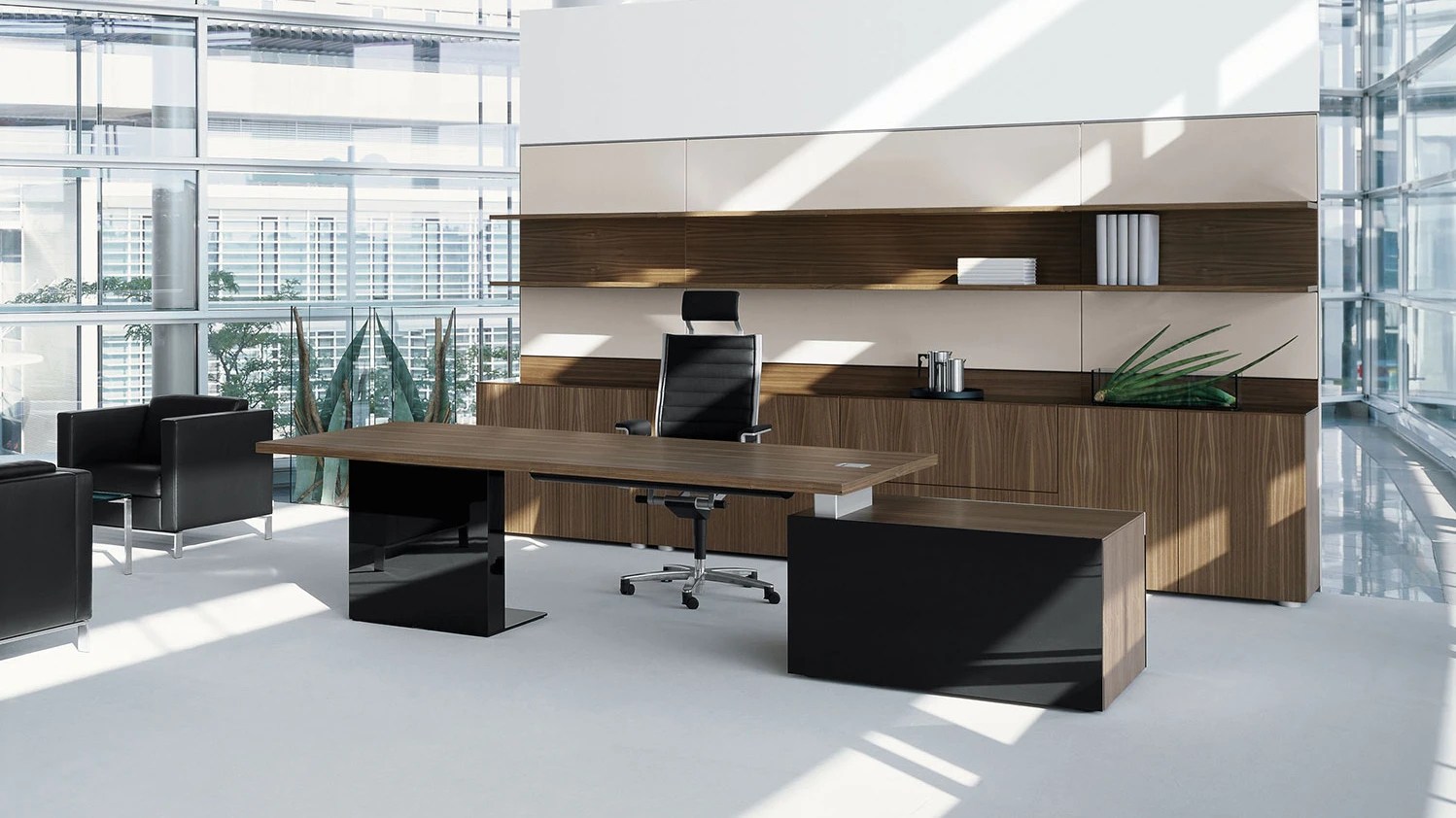
To lend diversity and creative scope to office occupants, staff members were given freedom to decide on the shape of their desks. Kovar & Köppl have chosen Bene’s
AL_Group (Design: Kai Stania). This series excels by its quality workmanship and perfect finish. Aluminium as a material that represents lightness, high-tech and mobility adds an urban flair and a professional touch to the office fit-out.
The two
conference rooms, used by the consultancy firm for meetings, events and seminars, are situated at one end of the office building. A glazed wall spanning the whole front – alternating from opaque to crystal-clear – separates the two rooms and ensures good lighting. Luminaires integrated into the walls blend perfectly with a large glass wall and discreet clerestory lighting. Massive wooden tables and elegant chairs are dominant. Works of fine art produce an elegant, intellectual atmosphere. The grey corner sofa by Norman Foster invites for quiet business conversations in an exclusive setting.
For a short break, colleagues get together in an open bar-type kitchen, which in fact is more of a cafeteria. With a flatscreen TV for teletext viewing and newscasts, the place also serves as an info point.
Mag. Katharina Schelakovsky