Bene Office Furniture
Subscribe newsletter
Lebensräume: Lernräume - Chi Minh City, Vietnam
12. Apr. 2011

Living spaces: Learning spaces

In our current Office.Info series, we take a look at spaces with special identities and examine the ways in which their design and functionality operate. This time: spaces that educate. ‘Spatial pedagogy’ and ‘learning architecture’ as catalysts on the path to knowledge and diversity.

There is something to the saying that spaces have character. Regardless of whether we want to work, learn, teach, communicate, entertain or relax in them – the space ‘created’ for a purpose clearly references the idiosyncrasies of its users and their activities. But whether or not it ‘works’ is another question and depends entirely on whether it reaches us emotionally. In the final analysis, impact really is more than the quadratic root of room height + wall colour + floor space.


You’ve probably heard all of the specialist terminology before: Blended Learning, Challenged Based Learning, Rapid E-Learning, CBT and WBT, and all the rest... What do they stand for? For new learning and the generation of knowledge with broad effects – both are in demand as never before.


Surrounding with soft skills


If learning methods and processes are changing, then we should also assume that the conditions in which learning takes place will have to continue developing too. Modern concepts of education and knowledge require the creation of inspiring spaces that promote creativity. After all, successful national economies have long depended on immaterial values that facilitate the generation of a knowledge-based society.

One development stands out with particular clarity: regardless of whether it’s primary school, university or professional continuing education, the process of one-way knowledge delivery is increasingly being transformed into an interactive model of knowledge transfer and learning support.

Knowledge is no longer served up in a neat package; knowledge means responsibility, curiosity, research, experience, discussion and networking. The dynamic that results from this process calls for appropriately designed environments. Massive auditoriums, with their focus on the lecture podium, are passé – even if that’s the current reality, but that’s another discussion.... What we need more of are spaces that encourage a balance of enthusiasm for education, creativity, fantasy, interaction, experimentation and presentation. Designs that are literally ‘sense-based’, focusing on visual, haptic, acoustic and olfactory elements that allow concentration and relaxation, as well as flexible settings, have been defined by Richard Stang and Frank Thissen. Both are professors at the *Stuttgart Media University*, and their research focus is on ‘worlds of learning’.
According to this line of thinking, learning space must transform into living space that focuses not only on academic content, but also on the personal development that consistently accompanies education. Space to evolve - in the best sense of the word!


An end to pigeonhole thinking!


As is so often the case in education questions, the Nordic countries are a few steps ahead – and this also applies to school architecture. What’s going on there would seem unimaginable just a few latitude lines to the south. For example, a school that has practically no classrooms.

In the meantime, the Hellerup School in Gentofte, Copenhagen, has already become famous. The concept, developed by the Danish architecture office of Arkitema is quite unusual: 750 pupils share a large space of 8,200 m² spread over three floors, without having separate classrooms.

The ‘Colosseum’ is the centre, a covered interior courtyard with broad stairs that can be used for various purposes. Along the interior courtyard, there are communal areas with furniture for sitting and reclining. A café and other communal areas offer spaces for interaction. In the quieter corners of the building, there are four ‘home areas’ (each of which hosts 75-100 pupils). These include a training zone for individual and group instruction, as well as three ‘home bases’. These home bases are hexagonal areas, each of which provides 25 pupils space for listening and learning that requires concentration. After these short phases, the pupils leave their home bases to interact in the large open area. Presentations take place either in mini-auditoriums in the centre of the home areas or in the ‘Colosseum’. The building’s floors are connected with several staircases, bridges, plateaus and balconies, adding exciting components to the space. If you’re expecting unbelievable noise throughout the whole school, you’ll be astounded. Although the pupils move through the space more often and use it in much more diverse ways than in conventional structures, the noise level is surprisingly low.

What’s truly fascinating is that nearly all of the areas are open, connecting together to form a single landscape. The only room dividers are furniture. The teachers’ offices, each of which hosts 5-6 teachers, and a single closed space for instruction, are the only exceptions. The building is permeated by this open atmosphere, which makes communication easier and creates a relaxed learning environment.


Academic teaching in the flow


Two completely different university architectural structures on different continents – despite their uniqueness, they have something in common: we’re talking here about the Rolex Learning Center in Lausanne, Switzerland, and the university campus in Ho Chi Minh City, Vietnam. Both buildings use the theme of water; both work with wave-shaped design elements and organic shapes; and both include some eccentric touches designed to encourage encounters and interactions.

The Rolex Learning Center is a building with a total space of 88,000 m². The first thing you notice is the wave-shaped, parallel course of the roof and floor, which makes the building appear unexpectedly light. Almost invisible supports hold the structure above the ground in places. Beneath the resulting ‘bridges’, people come from different sides into a wide open space and to the main entrance.

The wave shape creates a hilly landscape in the interior, without partitions between the individual areas. Numerous zones enable interaction. A few areas are available for concentrated learning, and there are glassed-in ‘bubbles’ for small group meetings. Whether vertical or horizontal: curves and bends determine the structure. The round interior courtyards also contribute to the effect, and their glass ceilings create visual openings to the outdoors. The building, designed by the Japanese architecture firm SANAA, mirrors the philosophy of the Swiss Technical University at Lausanne: it represents interdisciplinary collaboration and promotes it via its structure.


Sustainable design in Vietnam


Change of scene: Ho Chi Minh City, Vietnam. In the middle of the Mekong Delta, a university campus will be built in harmony with nature over the next few years. Their design won architects Kazuhiro Kojima, Daisuke Samuki and Trong Nghia Vo the silver medal at the global Holcim Awards 2009 for sustainable architecture. The buildings stand in perfect harmony with their natural environment, both in visual and technical terms. The softly sweeping ovals nestle against mangrove forests, and the campus doesn’t occupy very much land area. Wind and water flows have been incorporated into the design, allowing natural air circulation and shading to replace climate control systems to a large degree. To provide optimal ventilation, inspiration was drawn from traditional local building practices: bamboo mesh and mangrove wood make up the building’s facade.

The intersections of the oval buildings, flowing into one another, create several large halls and small rooms. Highly diverse opportunities for encounters and interactions are created here. The flowing design generates an ambiance that is as modern as it is close to nature.


One university – six buildings


Back to Europe: in Vienna, the new campus at the University of Economics and Business is being built right now. The master plan by Austrian architecture collective BUSarchitektur creates the framework for infrastructure, open spaces and individual building complexes. On a 90,000 m² plot, about 102,000 m² of architectonically diverse usable space are being created. The free space is meant to be a ‘Walk Along Park’ that connects the various places. The six building complexes come from different architects, yet they all share the same basic orientation. Public life, study and research come together in the open spaces and in the ground floor zones. Gastronomic highlights beckon visitors to the campus.

Among the project participants are the Japanese architecture office of Hitoshi Abe, the Spanish offices of Carme Pinós and NO.MAD Arquitectos, as well as Sir Peter Cook and his London-based CRABstudio. The German office of Zaha Hadid designed the futuristic Library & Learning Center, the symbolic and geographical heart of the new campus. This is where students have access to research libraries and service offerings. Workplace and lounge, communicative space and meeting point – there’s a place for all of this in the LLC. In the departmental buildings, structures that promote communication predominate, while the light-flooded auditorium centre, with its flexible lecture halls and self-study zones, creates a versatile environment situated between public and private spaces. And so a learning space becomes a living space....


Recreation with function


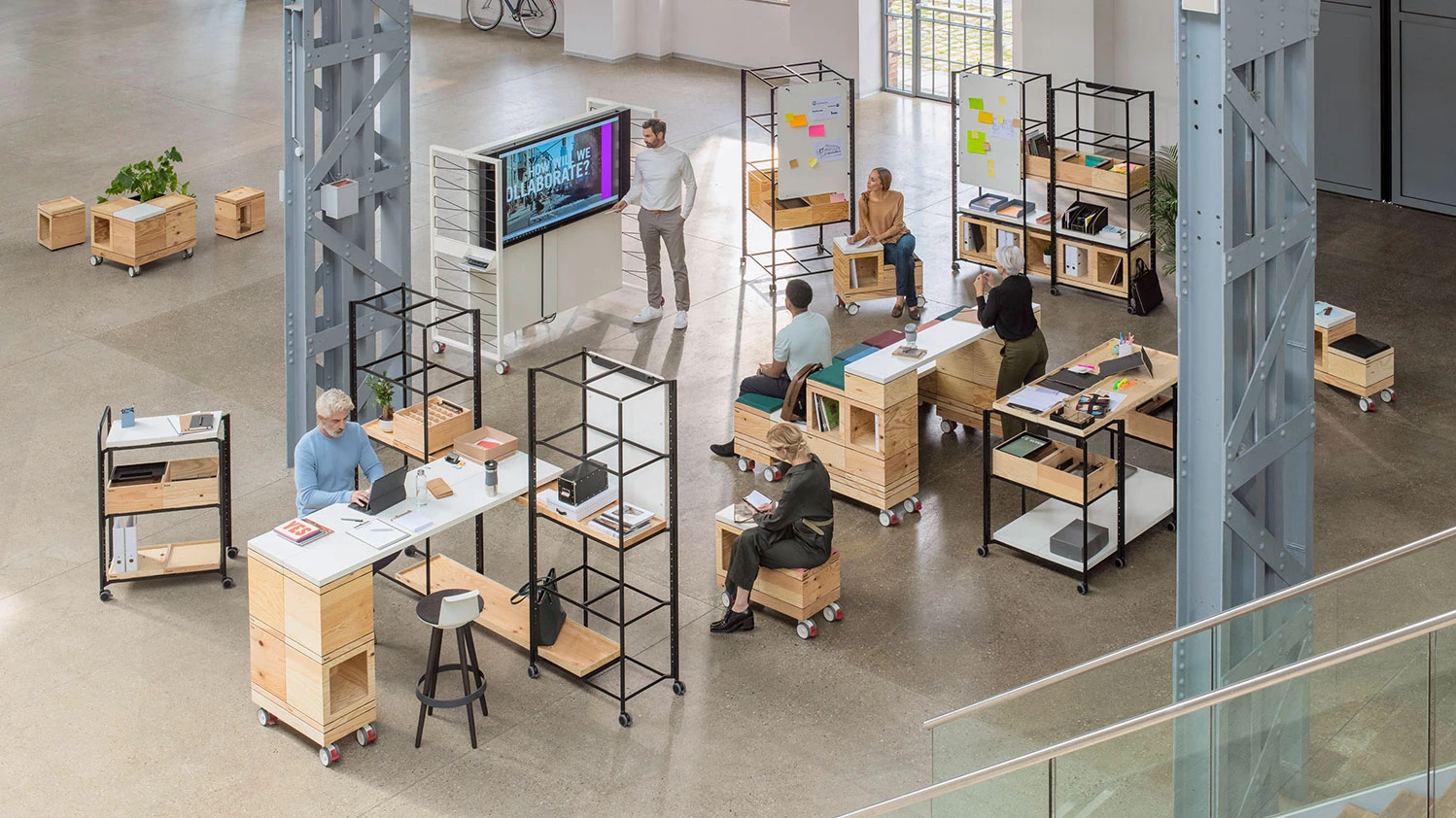
Apropos of living space: exterior spaces and recreation areas assume special significance in the framework of contemporary ‘learning architecture’. Open space situations create the perfect foundation for interaction, relaxation and creativity. At the Graz University of Applied Sciences, at Campus 02, a Bene PARCS-Installation installation has been tested for the past few months in the context of a student project. The interesting question is, ‘Can furnishings and interior design promote communication?’

The ‘balcony’ in front of the auditoriums is a beloved and intensely used zone on campus for group work, meetings and breaks. During events, it also offers an ideal view of what’s happening outside in the foyer below. The flexible and adaptable PARCS furniture modules are under intense scientific scrutiny and analysis. The results are due soon.


Event tip


Until 30 May 2011 in the Architekturzentrum Wien (Architecture Centre Vienna), you can see the exhibit, ‘The Flying Classroom. We’re Learning.’ The exhibit explores the interrelationships between architectonic space, teaching and learning – it’s definitely worth checking out.


Ronnie Sambor

Brigitte Schedl-Richter