Living Spaces: The Coffee House
In our current Office.Info series, we take a look at spaces with special identities and inquire into the ways in which their design and functionality operate. This time: an invitation to a coffee house, the multi-cultural “functional space” between the living room and InfoLABThere is something to the saying that spaces have character. Regardless of whether we want to work, learn, teach, communicate, entertain or relax in them – the space "created" for this purpose clearly references the idiosyncrasies of its users and their activities. But whether or not it "functions" is another question and depends entirely on whether it reaches us emotionally. In the final analysis, impact really is more than the quadratic root of room height + wall colour + floor space.
Between Vienna and Prague, people like to enjoy their coffee while ensconced in lush upholstery, while Italians prefer to have a quick espresso while standing or outside in front of the restaurant. In France, "le café" remains part of savoir vivre in the intellectual sense of the term. And in the last ten years we have heard statements from across the pond about coffee houses aimed at a young audience. These could probably be best categorised generically as "coffee shop" or "coffee to go" meets mobile workstation.
Every beginning is historic...
Nevertheless, the special ambiance of the coffee house seems to be a primarily European phenomenon. Especially in continental Europe, it has become an institution of social life, but the coffee house has also travelled with European immigrants.
The fact that the coffee house began in Austria is due more to historical accident (the Turkish siege of Vienna) than to evolutionary development. In any case, there were about 600 coffee shops in Vienna in the years around 1900, catering to a mainly male audience, because it was only fashionable for women to visit coffee houses with male chaperones. With its often integrated gaming and smoking parlours, the coffee house was already the central gathering place for social life back then.
At the beginning of the twentieth century, the coffee house developed into what we all imagine it to be today: a place for the exchange of ideas, creative discourse and artistic confrontation, a home for coffee house literati, political activists, freelancers and people looking to stay abreast of developments.
Originally classical
There were and still are numerous famous examples of European coffee house culture. In Vienna, Café Central, Griensteidl and Havelka all made history. In Berlin, people went to Größenwahn; in Prague, they met at the Continental, Arco or Savoy. Budapest was famous for the Abbazia, Paris for the Café du Dôme. In Zürich, Sprüngli was popular, and in Venice it was the Florian.
These coffee houses are mostly in the architectural style of their epochs. Art Deco, Art Nouveau or classical, often infatuated with decor, with a tendency towards the character of aristocratic living rooms or towards the sober utility of the early Bauhaus style – a typology has developed that has dominated the image of the "coffee house" far beyond the zeitgeist in which it arose. One example of the later generation that has been preserved in a cultish, atmospheric way is Café Prückel in Vienna, designed by Oswald Haerdtl in the 1950s.
Social Coffee Sphere
What makes the coffee house special, along with its espresso and coffee lounge successors, is its development as an organic functional space. People have consumed, communicated, waited, observed, met, worked and relaxed here. There is hardly another public space that is used in such a complex variety of ways. From gossip and chin-wagging to political and intellectual debate, everything can happen here. Maybe it has to do with the exciting hybridity between the living room ambiance and an InfoLAB. Beween seeing and being seen. You can be just as easily be alone here as you can be in the spotlight. You can indulge in "social separatism" or network for all its worth. The coffee house offers a very real platform for all kinds of self-representation. You could almost believe that Mark Zuckerberg did nothing more than elevate the coffee house concept to a virtual level.
On another yet analogous level, the "cafe sphere" has become inseparably intertwined with a very different "living space": the office. Zones and areas such as the cafeteria or coffice bring a new quality of life and encounter into the world of work.
The next generation
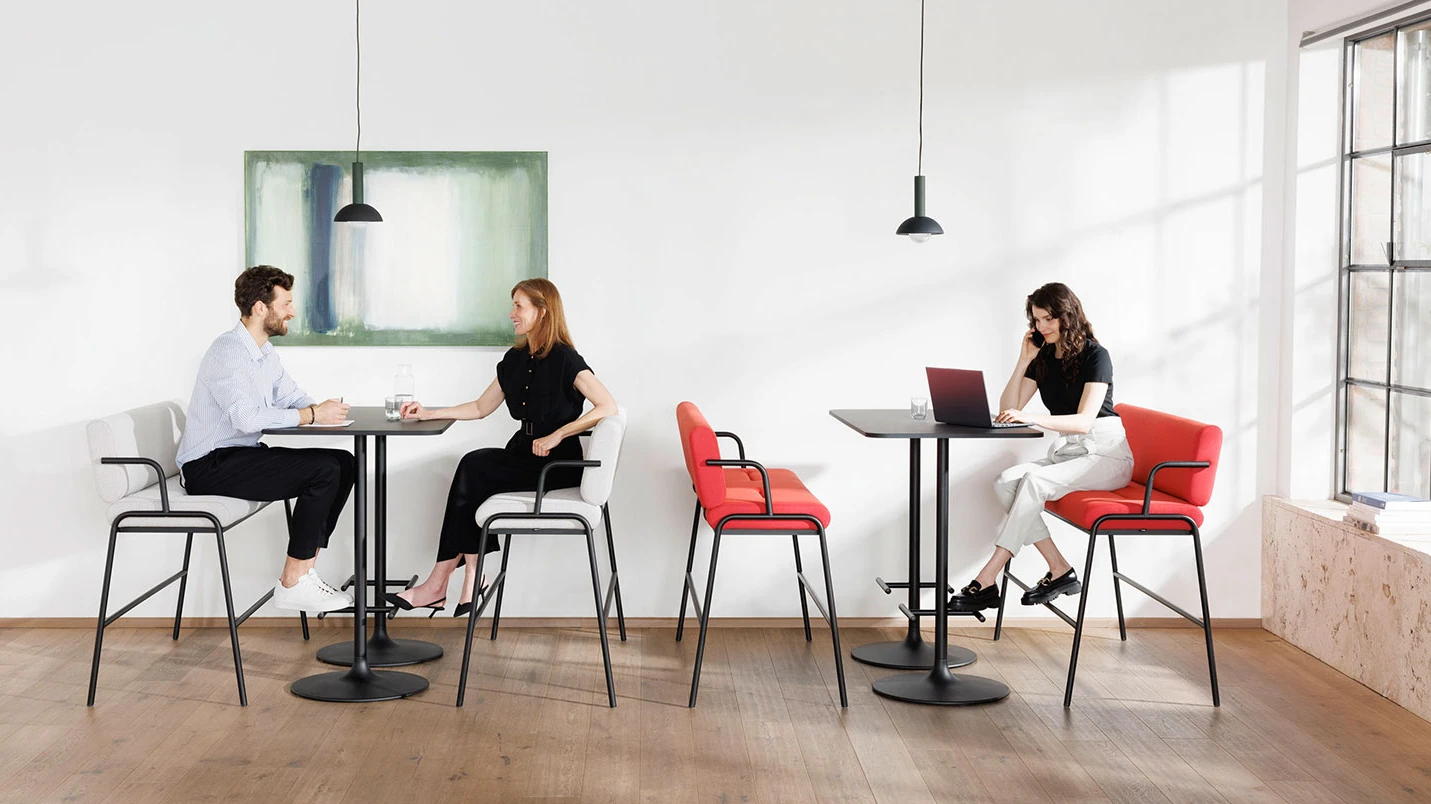
Nevertheless, something does appear to have changed. The "social biosphere" of the coffee house has gained formal recognition. Business agreements are made every day at the bistro table. All you need is a power socket nearby, and you can work on your laptop here. And once you’re logged in, your current location is but the starting and ending point for virtual communication. A telephone call from the coffee house? Don’t be shy - this is professional. If the boundaries between work life and private life are blurring, then so are the places where we perform both. But the innovation factor still remains high – or maybe it does precisely because of this. Because in our digital day and age, the coffee house is a fruitful incubator for new things. The rumour is that the Internet platform Flickr was dreamed up at Ritual Coffee Roasters in San Francisco. There the Web 2.0 scene found an appropriate place to enrich our world with a series of interactive possibilities for virtual cooperation.
Apropos USA – some serious competition has come across the pond to us here in Europe. Highly professional coffee shop concepts with aggressive distribution and subsidiary structures are successfully winning over a young audience and making the "experiential dimension" of their products the centre of a marketing-supported lifestyle. The coffee house interpreted in line with the market, with all of the technological standards that the Facebook generation expects.
Flexible Free Space
"For me, it’s completely normal to go to a coffee shop in between meetings and do my daily work", says Dani Terbu, a communications manager with a knack for cross-medial work. "And I really don’t want a fixed office right now where I have to go. I have learned how to tune out the noise in public spaces so I can work and concentrate. I also find working in different surroundings both practical and inspiring." Changing locations keeps you flexible, at every level.
For 14 years, Terbu has been underway both professionally and privately in the Web. A Web 2.0 expert who knows how to find new communication channels, she went to work for herself about one year ago. Her topics are social media and communication.
The fact that another idea came up while Terbu was in the midst of professional change was a logical result of her current working situation. "Because I didn’t have an office, my colleague Barbara Haider and I always met for breakfast. In a different place every time. So then the idea of starting up a breakfast blog came along naturally."
And the online community likes to look up their subjective recommendations for the best breakfast places in Vienna: diefrühstückerinnen.at regularly gets about 70,000 hits. And it just turned into a recent cooperation with Wiener magazine – Terbu & Haider have put together five breakfasts for men for every occasion, from the hangover breakfast to the pick-up date breakfast – everything’s there.
The Great Coffee House Experiment
The Great Vienna Coffee House Experimentexhibition in the design space of the Vienna MAK is currently looking for signs of and questions about the future of the coffee house. Under the direction of architect Architekt Gregor Eichinger (himself a café afficionado with his work on Café Stein, the Wrenkh restaurant, the Kunsthallencafé and Café Halle in Vienna), with project management by Thomas Geißler (MAK curator for design), and together with the MAK’s 2011 designer-in-residence Julia Landsiedl, the exhibition explores how the Viennese coffee house of the twenty-first century should look. The high point and culmination of the design experiment will be in October when models of the best designs are constructed for a test drive in the MAK. This lets us look forward to exciting results. It might even tell us whether what Alfred Polgar considered to be the quality of coffee houses eighty years ago will still hold true: "For ten years, a couple sat every day for hours in a coffee shop. That’s a great marriage! No, that’s a good coffee house."
Brigitte Schedl-Richter
Photos: Alexander Ullrich I Kunstdirektion Wien, arge|zeit|media, Julia Landsiedl © kramar/MAK, 2011