Bene Office Furniture
Subscribe newsletter
Bene Sortimentsbuch: Räume schaffen - wider den Zufall
8. June 2010

Bene product catalogue: Creating spaces – and not by chance

Office layouts and spaces aren’t created by chance. They are the result of a carefully considered concept – or at least they should be. Because a conscious decision can support future work in an ideal manner. The new Bene product catalogue offers insights into this topic.

Somewhere in Europe, 1987: a long corridor, seemingly endless rows of doors to the left and right, not a person in sight. Then a door opens, a man steps out and walks quickly down the hall. He opens another door and disappears into a room. Silence.

Three years later, somewhere in the USA: "No, not me – you need to talk to Clark. Over there, the fourth desk to the right. Hey Clark, someone wants to talk to you!" A broad office space, filled with innumerable desks where innumerable employees sit, a babble of voices, bustling activity. The man heads to his destination.

These are the dominant office layouts of recent decades – cellular offices in Europe, open offices in Anglo-American countries. Yet recently there has been a shift away from these "stark" office designs. New technologies, changed requirement profiles for office spaces and companies, and a new self-understanding have led to a re-examination of traditional offices and further innovation.


Selecting an office layout


Today, office design focuses on people and their communicative behaviours. Interpersonal contact is promoted, creating a motivating work environment. The optimisation of the individual workplace is no longer in the foreground; instead, a sophisticated and integrated building concept is in demand – for different office scenarios. In the meantime, people have realised that the selection of an appropriate office layout has a decisive influence on employee performance and motivation. This makes office layout a factor for success in office design. Every office type offers different approaches to finding solutions in terms of communication, concentration, flexibility and efficient use of space. The idea is to find the right solution for individual needs.


Four office types and their features


The cellular office is characterised by stringing together single and multi-person offices along the building’s facade; a common corridor provides access. In comparison to the original cellular office, there have been changes in recent years; for example, a small open shared area was added. The cellular office is particularly well-suited for companies that want to support autonomous work that requires concentration and facilitate confidential meetings. Offices with a door are still regarded today as a status symbol. A relatively low maximum occupancy rate is taken into account in this type of office.

The combination office combines standardised single or multi-person offices that consume significantly less space. Communication, exchange and interaction take place in the multifunctional shared area – the so-called middle zone – located in the middle of the office. Support areas are also located here. The corridor walls are designed to be transparent; this enables a line of sight to the middle zone. In combination offices, people switch frequently between individual work requiring concentration and communicative project or team work. The maximum occupancy rate is greater than in the cellular office.

In the team office, there is a mix of office layouts within the office floor or building. Variability and flexibility are emphasised. The team office is designed to be partly open, transparent, and modifiable at short notice. It is suitable for a wide array of work, such as team building and structuring, project work, concentration, and communication. The maximum occupancy rate is also somewhat higher for this office layout.

The open office combines the advantages of several office types in large-scale application scenarios. Communication, exchange of knowledge and quality of interaction are the focus here, yet without dispensing with the possibility of privacy. Employees choose the zones and areas that are best suited for their activities. Compact, non-territorial workplace areas enable a highly efficient use of space.


Space construction and partitioning


All of these office typologies are shaped by vertical surfaces that create and partition spaces, that divide office floors into either closed or open areas. They structure the office environment, providing either visual or acoustic shielding, or promoting openness and transparency. All of Bene’s room systems are technically designed so that they do not interfere with the building's architecture, yet they can accommodate building tolerances and ceiling movement.

Regarding space creation: closed office units – from floor to ceiling – are constructed. A high degree of acoustic screening ensures peace and privacy.

Visually, both screening and transparency can be achieved, the latter by using glass surfaces. When applied to cellular and combination offices, closed-off office units facilitate individualisation and work that requires concentration.

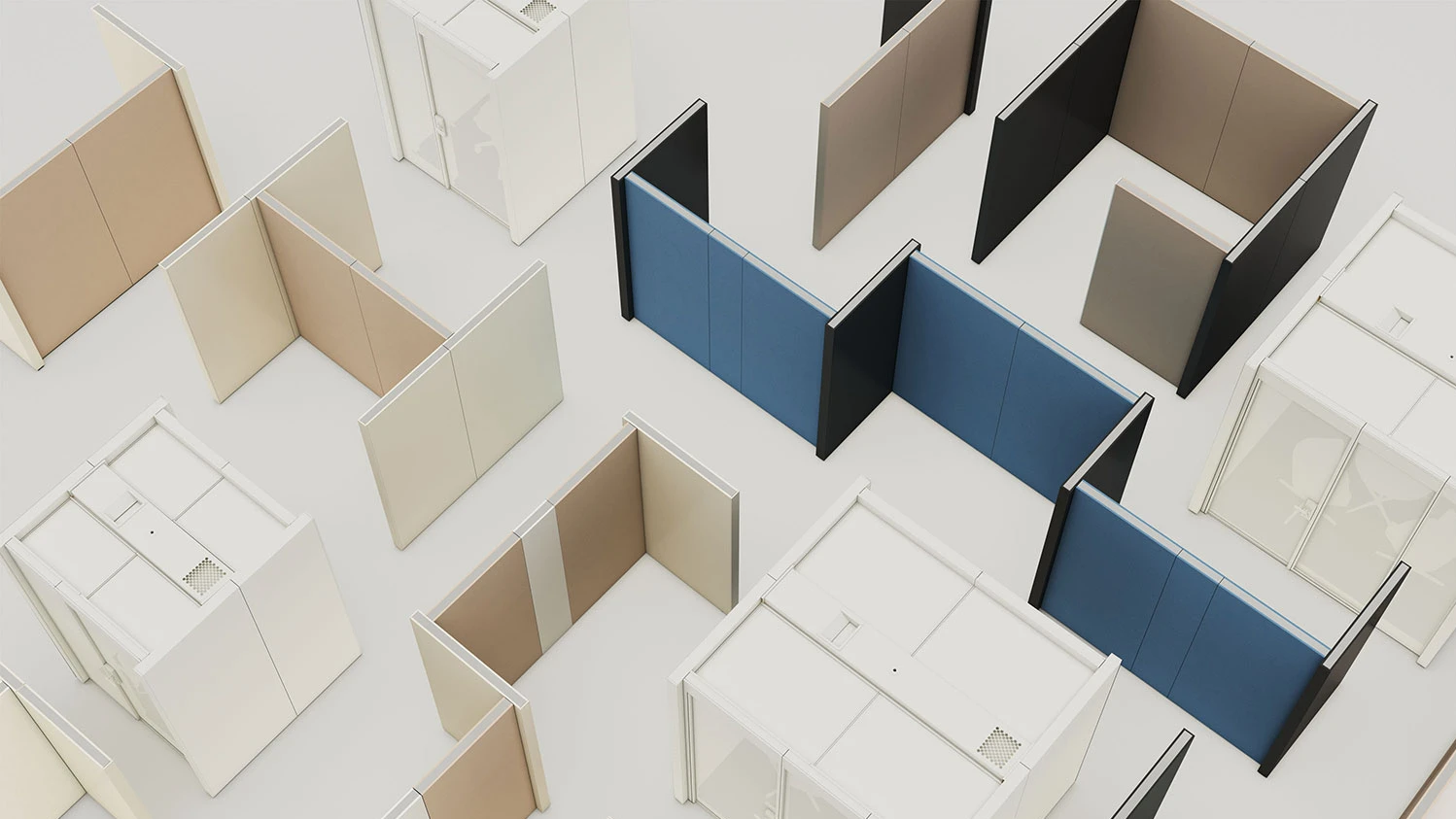
Cubicles offer an interesting, unique form of space construction: room-in-room solutions with their own ceiling structures. As acoustic barriers in open office landscapes, they serve primarily as meeting rooms, think-tanks with temporary workstations, recreational spaces, or rooms for activities that demand high levels of concentration.

Regarding space partitioning: they subdivide the open layouts of team offices and open offices. They structure the space and provide visual perception of the space when standing, thereby improving and accelerating communication. When seated, people can have privacy and can concentrate thanks to the vertical screening elements. The varying heights of vertical surfaces create different degrees of screening, which produces acoustic, visual and psychological effects – everything is possible, from a simple spatial structure to a partitioning scheme with individual spatial qualities. In open layouts with partitioning, further workstation density is attained, thereby increasing the efficient utilisation of space and creating paths that are shorter and more straightforward. Team building is made easier; people are involved in what’s happening. Partitioning elements are flexible during renovations and create the possibility of a third working level - with the advantage of organising storage and office supplies within arm's reach. Partitioning is used primarily when hierarchical structures are flat.

The selection of an office layout - based on an intensive analysis - and the creation of spaces constitute the first major step in planning an office that optimally supports employees in their daily work.

Anna Voltren