Patterned fabric returns to centre stage
Are you the type of person who wears stripes or do you prefer checks? Have you ever worn pepita or perhaps a more extravagant paisley? The liaison of fabrics and patterns is as old as history and has retained its fascination for designers even today. There is a sheer endless number of variations, and some of the classics might even be found in your own wardrobe, such as Burberry check, fishbone or houndstooth. Incidentally, the first tartans were encountered in Japan, long before the Scottish clans used them to declare their ancestry and patterns had very specific signification even in those times. The symbolism in clothing or expressed by spaces was naturally never purely coincidental and soon this became highly symbolic. It created a sense of belonging or exclusion, was preferred by royals or the lesser privileged – all depending on what they wanted to represent.People change, and so do spaces
The role played by textiles in architecture was similar. Wallpaper, curtains, carpets and upholstery have all shaped their eras. Spaces developed visual and tangible personalities with the help of fabrics and patterns. However, for a long time patterns were mainly used in two areas and concentrated on either representative or private rooms.
Office architecture long seemed "tough" enough to "stand up" to new materials and surfaces. But at some point the "practical/cool/wipeable" mentality finally ran its course and the search began for a new, more emotional approach to the office. Bene recognised the trend in the 1970s and was one of the first to open up office design to entirely new perspectives, created by the remarkable, dynamic collection by Mira-X. Design icon and architect Verner Panton, who designed furniture such as the Panton Chair for Vitra and the interior of the "Spiegel" publishing house in Hamburg, developed psychedelic patterns in bold colours for the Swiss Textilverlag with a preference for red in an endless number of shades used for carpets and wall elements. Bene acted as general representative.
Horizontal impressions
While this first "textile" revolution shook up the conventional look of the office at the time with a veritable explosion of colour, the next generation combined spatial functionality and design at the highest level. Designer and architect Angela Hareiter developed sophisticated fabric collections for Bene in the 1980s also with the aim of eliminating day-to-day office greyness, albeit with a more subtle approach. Meinrad Fixl, long-standing advertising manager and design expert at Bene from the start, describes what was unusual about the collections: "The fabrics created a symbiosis with the architecture, focused on walls and utility spaces, and influenced the entire perception of the room with their fluted, horizontal structure." A pattern or colour was no longer an end in itself, but the special type of weaving gave the fabrics a chameleon, multidimensional look. From that time on at the latest, textiles had become an integral part of Bene – and of the office.
The office becomes living space
Walls, panels, room dividers, seating – they have all played a role in the textile "revolution" over past decades. Fabrics with highly developed qualitative product specifications now act as design statements, but also assume technical functions such as sound protection and screening.
However, there is a remarkable contrast with earlier years and Fixl recognises new potential: "Fabrics and patterns used to be part of the architecture, but today they are seen in a decorative context. This also enlarges the range of possible uses. Whether large, expansive wall surfaces or individual seats, textiles have become extremely versatile – as required by the incredibly rapid changes in the office as a living space."
And that is also the reason for these developments: diversified working environments that are inspiring, communicative and informal, encouraging recreation and creativity while functioning as living space and not just somewhere to work, are demanded by people who also have a liking for colour, soft and comfortable seating, varying surfaces and a changing appearance.
Good fabric by KVADRAT
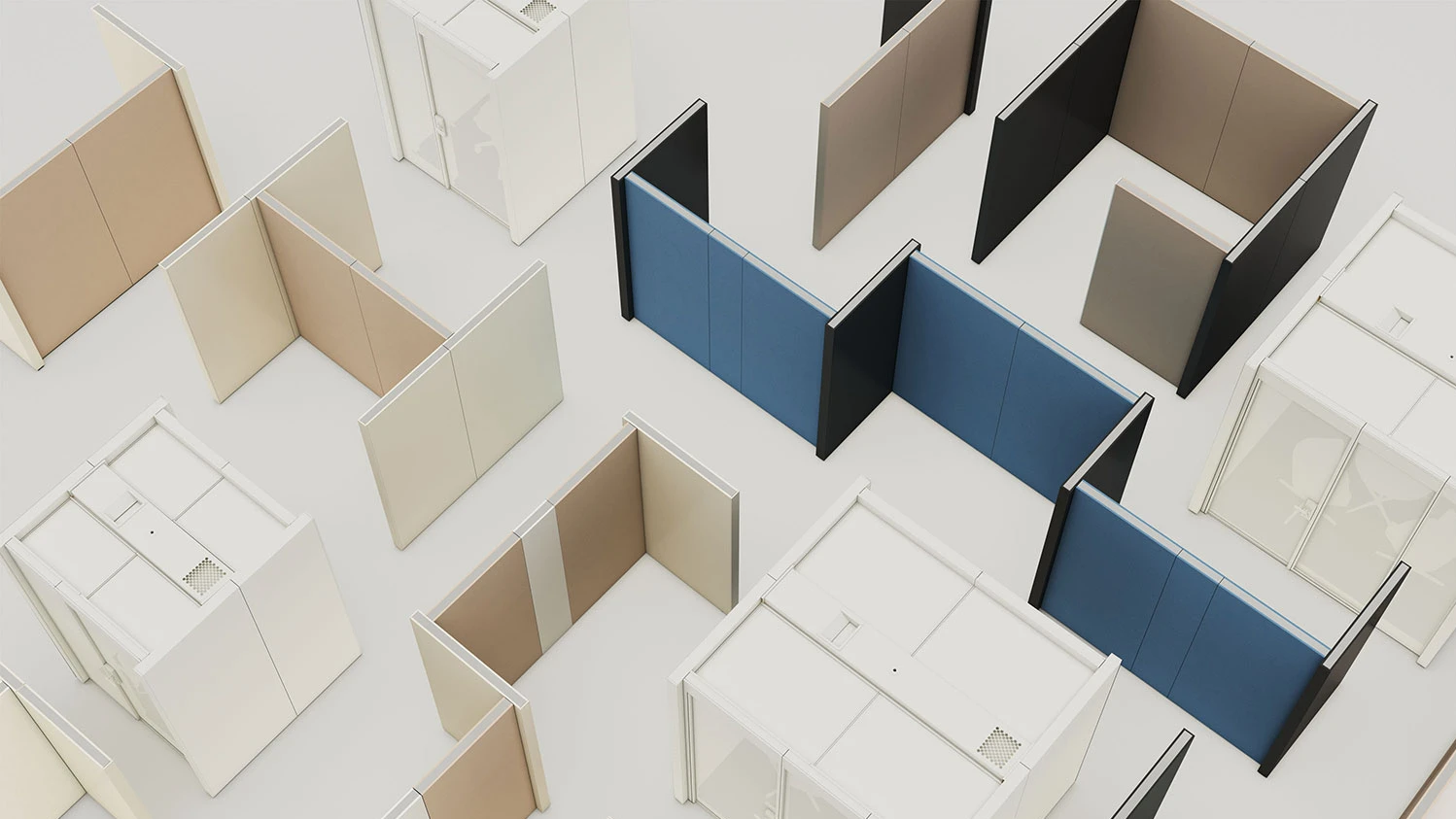
PARCS and its multifunctional modules heralded a new generation of textiles at Bene. The Danish brand KVADRAT– the main supplier for some of the most notable architects, designers and furniture manufacturers around the world – has been a close and innovative cooperation partner since the product launch.
The company was founded in 1968 as a small textile firm and resides in Ebeltoft on the east coast of Denmark. KVADRAT is now represented in 20 countries worldwide and 90 per cent of its overall sales are exports.
Alongside the extraordinary product quality and sustainable production processes, a main characteristic of KVADRAT is its careful selection of colours and patterns for its collections which some think reflect the clear light of Scandinavia and the ocean view offered by all of KVADRAT’s offices. It is not without good reason that they were chosen for some of the most highly symbolic and architecturally interesting buildings in the world, such as The Gherkin in London, the Museum Of Modern Art in New York, the Walt Disney Concert Hall in Los Angeles, the Reichstag in Berlin, the Guggenheim Museum in Bilbao, the DR Koncerthuset in Copenhagen and the Opera House in Oslo.
"Colour is permanently linked with texture and shape. It is more than just the Pantone code" is the credo here. Bene’s collection of seating furniture boasts a selection of no less than 350 colours.
Welcome (to) Greenwich
A new textile highlight was presented by Bene just recently at Orgatec: Greenwich is the name of the exclusive collection of fabrics created by the British designer duo PearsonLloyd and produced by KVADRAT, which will fill offices with new colours and patterns. The story behind the design of the extensive high-quality jacquard fabric is quite fascinating. The designers were intuitively inspired by the network of paths in London’s Greenwich Park; they created an abstract form of individual elements which was implemented into a large pattern repeat. The new fabric is predestined for use in the furniture lines also designed by PearsonLloyd: DOCKLANDS and PARCS. Stimulating to look at, yet without being distracting, Greenwich lends any type of furniture particular character and originality. The organic pattern loosens up large vertical surfaces and brings a subtle dynamism into the office.
The Greenwich collection includes the four main colours grey, cyan, green and yellow, each with three colour schemes – based on the typical colours of modern street images. But the essential aspect in the definition of the colours was their suitability in office environments: viewing these colours should be energising but certainly not over-stimulating, just as we look for variety without overkill in the other living spaces where we are active. Or even better: a prudent dose of inspiration.
Brigitte Schedl-Richter