She's the boss...
... in her office. If there's female management, then there must also be a "female" office, right ? A survey among female managers.Hasn't matriarchy already arrived? If we are talking about female students, politicians or managers, then, the male representatives of these occupations are swept under the table without a sound.
We don't deny at all that men are still around, and even have the majority of management positions.
- But for how long? If one follows the thinking of female senior executives, men are simply missing, or have repressed, one dimension or another, particularly those dimensions which have something to do with emotions, intuition and "gut feeling".
For Csilla Szechenyi, head of the advertising agency, Szechenyi & Partner, it's pretty clear: "Women have a basically different style of leadership than men. They are willing to recognize feelings in their working life as well as in their private lives, and to trust those feelings. They let emotions and intuition influence their decisions. By exhibiting their true personality in their style of leadership, they are simply more authentic."
Birgit Reisner, co-manager of Bipa, also finds that female managers have more empathy than their male counterparts: " Only hard facts count with men. As a result, their dealings with female staff, in particular, require a more forthright personal approach."
For Eleonore Gudmundsson, international PR head of the crystal firm, Swarovski, the woman manager's advantage lies in her ability to be able to concentrate on several things simultaneously.
Supply-oriented versus demand-oriented office
If female management, as we can see without doubt from the above, is different, (many would not hesitate to say better), than male management, this ought to have an effect on the office itself. What might the "female" approach to the office be?
Birgit Kuras, director of the Department of Capital Market & Company Research for RZB, sees the issue, as she should in her job, from a sober economic vantage point: "Female senior executives behave in a demand-oriented way in the office, as they take into consideration the impressions they make on the outside world."
In other words, women think about how to furnish their office so that female visitors feel comfortable and communication is encouraged. They also show, according to Ms Kuras, more imagination in the furnishings which is why they can't be pinned down to a preference of one material over another. Ms Szechenyi is quoted: "In our firm, steel and aluminium dominate, with wood and glass taking second place." Ms Gudmundsson prefers veneers, aluminium and glass; Ms Kuras, wood and steel.
On the other hand, according to Ms Kuras, men's offices are furnished uniformly.
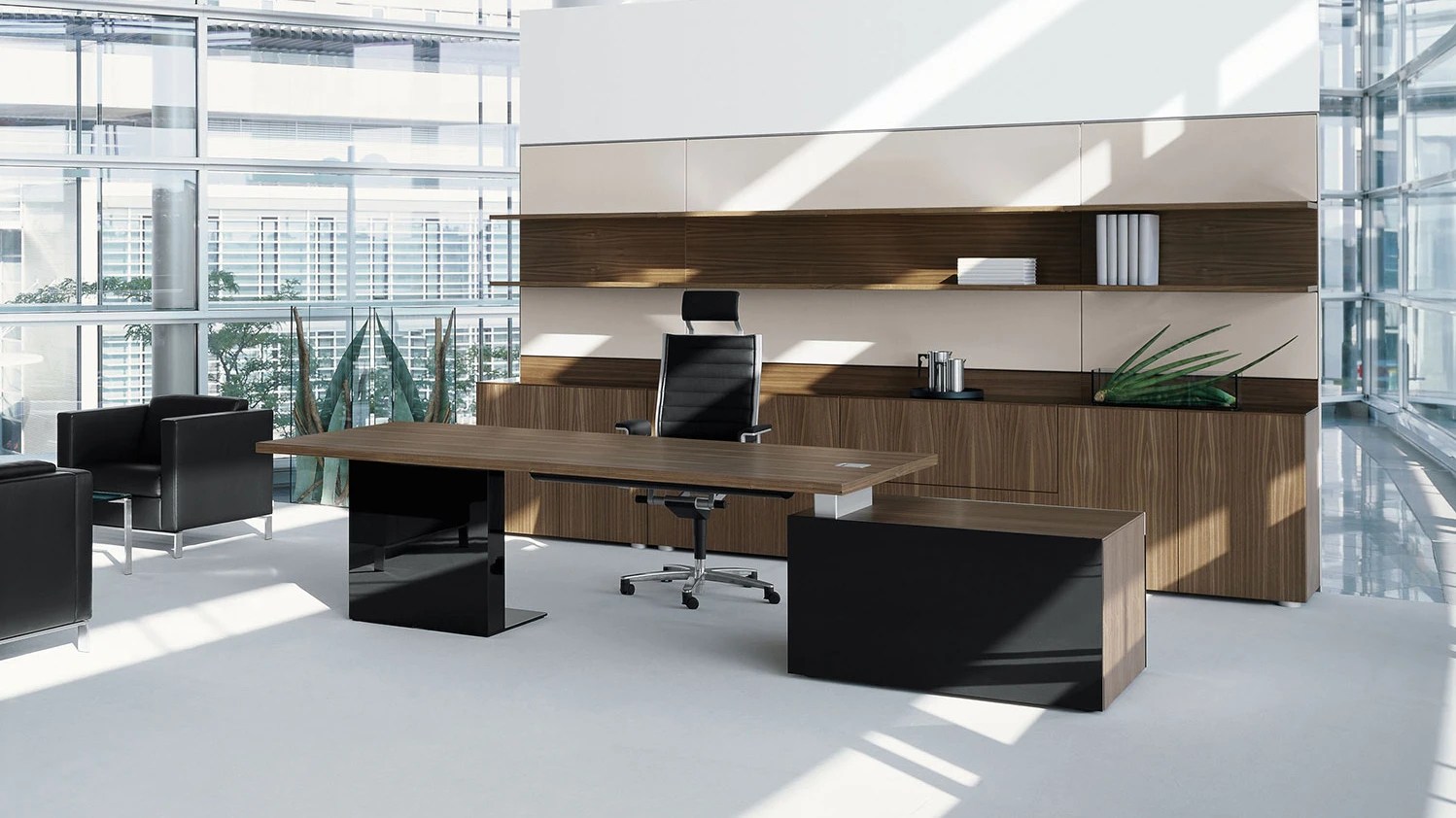
"The typical manager's office is like this: a large desk, leather couch and three family photos " supply-oriented, along the lines of "this is my office and if someone doesn't like it, they don't have to look at it".
Csilla Szechenyi readily agrees with this observation:
"The most important thing for both men and women is functionality. A woman, however, pays more attention to atmosphere, mood and well-being."
Her own office is light, doors are wide open. "For me, light and openness are important. Thoughts need to flow. No one should feel closed in." The office itself is old-world, with double doors, high ceilings, star parquet floors etc. but the furnishings are specifically modern. Contemporary art is on the walls with even a self-made picture or two. Szechenyi refuses to hang traditional art even though she comes from an established Hungarian noble family, whose castles must surely still have a lot of this type of art "kicking" around.
A TV set on the wall projects music videos and the radio is on, which one would expect in a creative industry. "Corporate identity is particularly important for an advertising agency. The office is a place of communication. Our visitors need to know immediately, whom they are dealing with. The mood that we evoke generates directly over into business."
In Ms Gudmundsson's office at Swarovski in Wattens, there can be no misunderstanding about where you are. The office is decorated with crystal ornamental objects: a so-called Apollo bowl, a Viking ship , a lamp shaped like a shower of crystal rain, a candlestick and also crystal components attached to the window frames that reflect light. "These things give me tremendous pleasure, when I look at them. Crystal catches the light and gives even the greyest office an aura of colour. It is even supposed to have a healing effect, and I would surround myself with it even if I didn't work for Swarovski."
Does an office reflect one's personality? Ms Gudmundsson says: "In my case it does. It has atmosphere, anthracite grey Bene furniture, my own landscape photos, crystal. The Apollo bowl, for example, reflects my personality, frosted, standing on metal legs finished off with coloured crystals. I also need to have more than one leg to stand on and, at the same time, a centre in which to collect my impressions, just like a shallow bowl."
No replacement for home
Atmosphere, well-being, that's all well and good but one thing female managers all agree upon, and certainly don't want, is to make a home out of their office. As Csilla Szechenyi says, "keeping the extreme value of the emotions in mind, truly private things such as family photos have no place in my office".
Ms Kuras also doesn't like things to be too comfy. "I very definitely don't make my office a home. I cannot stand plants in the office, like the ubiquitous ficus beniamini standing around in one of those ghastly soil-substitute globes."
However diverse management styles may be between the sexes, there is one point, sadly discovered by the writer of these lines while doing his research, which shows that woman managers are completely in line with their male counterparts; they are fundamentally impossible to reach. This is entirely in keeping with relevant studies revealing that top woman managers spend 75 percent of their time in meetings and conferences.