It’s all on the surface
Perfect beauty requires experience: At Bene, experienced veneer experts ensure the quality of veneered furniture through exceptional know-how. We will present interesting insights into the Bene veneer workshop.»It is mysterious. Is it because wood, whether carved, cut or planed, always remains alive? It has lived, like something hidden that continues to live on within us. It is amazing how rarely people that work with wood seem unhappy or bitter.«
J.B. Priestley, Writer
Intelligent diversity
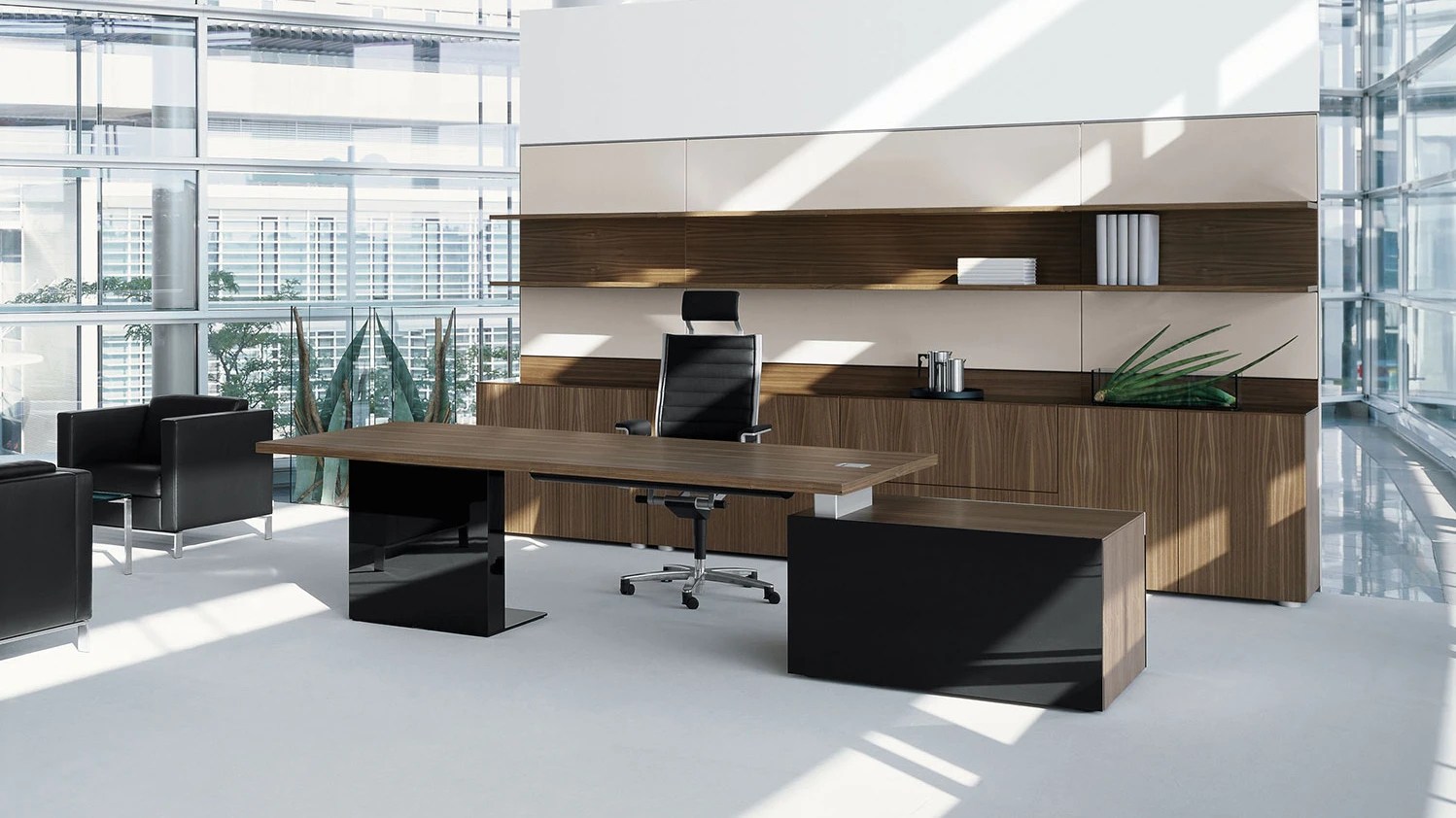
Fine woods ensure the quality of the products. Bene has been processing only selected veneers for more than 30 years. The portfolio was expanded in 2006. Classic wood types such as beech and cherry aside, choices now also include oak and maple and trendy wood types, the likes of nut, Makassar and Zebrano in twenty different hues and grain qualities. Meanwhile, Bene’s veneer range has increased to one of the largest in the furnishing industry. Bene has established itself as a premium supplier.
Nature in symbiosis with industry
Alive, authentic and exclusive: The material wood is as unique as Bene’s products. Nature brings forth individual shapes and colours, no two tree trunks or types of veneer are alike. Bene successfully expanded its veneer portfolio by launching mass-production of the second varnishing system for large-pored wooden surfaces. Intelligent mass production and ideal wood quality coupled with virtuous craftsmanship yield an excellent veneer appearance. Thus, nature and industry create an impressive symbiosis embodied by exclusive furniture.
Uniform veneer appearance
Bene provides "just in time" production, which means that almost everything is purchased and produced commission-based. As a result, all types of veneers are specifically selected for certain furniture and office layouts. This does not only allow for upgrading furniture pieces with select veneers, but also for selecting uniform veneer types for each room or storey. Mass production with individual quality standards.
Bene veneer workshop
In 2006, the Bene veneer workshop in Waidhofen an der Ybbs crafted veneers equivalent to the total surface of 160,000 m2, which is as much as 32 football fields, and production numbers are steadily rising. The know-how of many years in combination with state-of-the-art equipment, skilled craftsmanship, even performed by hand, attest to the expertise of Bene's veneer shop and the quality of the products.
The Bene veneer workshop team includes currently nine veneer experts and six solid wood specialists, as well as nine other staff members responsible for veneer purchasing.
In the following we have outlined and illustrated a few production steps:
Selection of veneers and cost calculation in relation to the rooms or storeys is performed to ensure a uniform veneer appearance (colour, grain quality etc.).
First rough edges of unprocessed veneer sheets are removed to smoothen the edges.
Next, straightened veneer sheets are transformed into veneer plywood boards, which are larger veneer surfaces that have been glued together.
The veneer plywood boards are placed on a light table to be inspected for possible defects.
Only first-grade veneer plywood is processed to raw chipboards or compact panels.
Skilled handicraft applies the final touches:
Edge sanding | Sanding of solid wood edges
Veneered and edged panels are stained by hand. Bene uses aqueous staining solutions depending on the varnishing system.
Subsequently, the stained surface is lacquered to protect the surface.
Bene’s paints are UV-curing and dry immediately. Consequently, processing can be resumed upon varnishing.
We use only water-based varnishes low in solvents that distinguish themselves by accomplishing high surface strength after UV-based drying. This special varnish provides also protection against light and reduces subsequent darkening or yellowing of wooden surfaces.
Bene regularly inspects the quality of surfaces. Scratch and water resistance of surfaces is monitored once a month, in addition to surface adhesion properties of the varnish. Colours of staining solutions and surface finishes are constantly monitored. This helps Bene to accomplish a high level of quality.
Nicole Schemerl-Streben