The world of megabrands: Swiss cosmopolitanism
Every Swiss bank appears to portray an aura of discretion. Credit Suisse has even more things to offer – stability, prestige and efficiency, to name a few. Currently, the tenth largest bank of Europe, Credit Swiss has developed a brand strategy that embodies the successful symbiosis of tradition and dynamism in a global banking world.The Swiss company that enjoys a long tradition has successfully reconciled tradition with innovation. A new brand management approach pioneered in 2006 even fuses both aspects: tradition of innovation.
Schweizer Kreditanstalt
The bank boasts indeed a long tradition: Credit Swiss was founded in 1856 by Alfred Escher under the name Schweizer Kreditanstalt (SKA), transforming the city into the leading banking and economic hub of Switzerland. The aim of its foundation was to further develop the railway network and promote industrialisation in Switzerland. Innovation was adopted as the corporate strategy early on. The first periodical banking publication appeared in 1895, titled "Effekten-Kursblatt", under the auspices of SKA.
Global Player
Much has transpired ever since the foundation stone was laid for Credit Swiss: areas of operation were added; new branches were opened – first in Switzerland, then globally. Mergers and acquisitions further spurred SKA's growth, one of the most instrumental steps for spawning the co-operation with First Boston Corporation in 1978. Almost ten years later, SKA acquired the controlling interest of the company. In the 1980s and 1990s a flurry of activity was seen at Credit Swiss: acquisitions, mergers and alliances helped further the size of the company. At least since 2006, Credit Suisse has presented itself as an integrated global bank headquartered in Zurich, London, New York, Hong Kong and Tokyo.
Three divisions under one roof
Credit Suisse unites three divisions under one roof: investment banking, private banking and asset management. The integrated structure helps to effectively and promptly meet complex customer needs, ensuring that clients have access to products and services of all three divisions. Not a simple but a necessary requirement in times of global financial markets, where respectability and up-to-dateness are paramount along with reliable networking and a gaugeable speed of processes.
Logo? Logo!
Every brand comes with a logo – be it a consumer goods company or a financial services provider. Credit Suisse's example shows that the search for visual identity was clearly defined by willingness to change. At the beginning of the 20th century, the cursive writing of SKA was replaced by a coin-shaped logo, 20 stars encircling the three initials – a symbol for the headquarters and its branches. In 1952, an anchor was added to lend visual impact to the claim; "firmly anchored to trust". The "Wermelinger Kreuz" (Wermelinger cross) was adopted the following year to represent the label until the introduction of the currently used sign in 2006, two triangles in the shape of a sail, promising a safe and dynamic passage.
Goals and principles
Credit Suisse aims high, seeking to become the best and most respected bank worldwide. Innovative and integrated solutions pave the way along with a culturally diverse and open-minded staff. The company leans on three principles for accomplishing said goal:
+ Customer needs are always prioritised
+ Teamwork is the foundation of the business
+ A good reputation is paramount
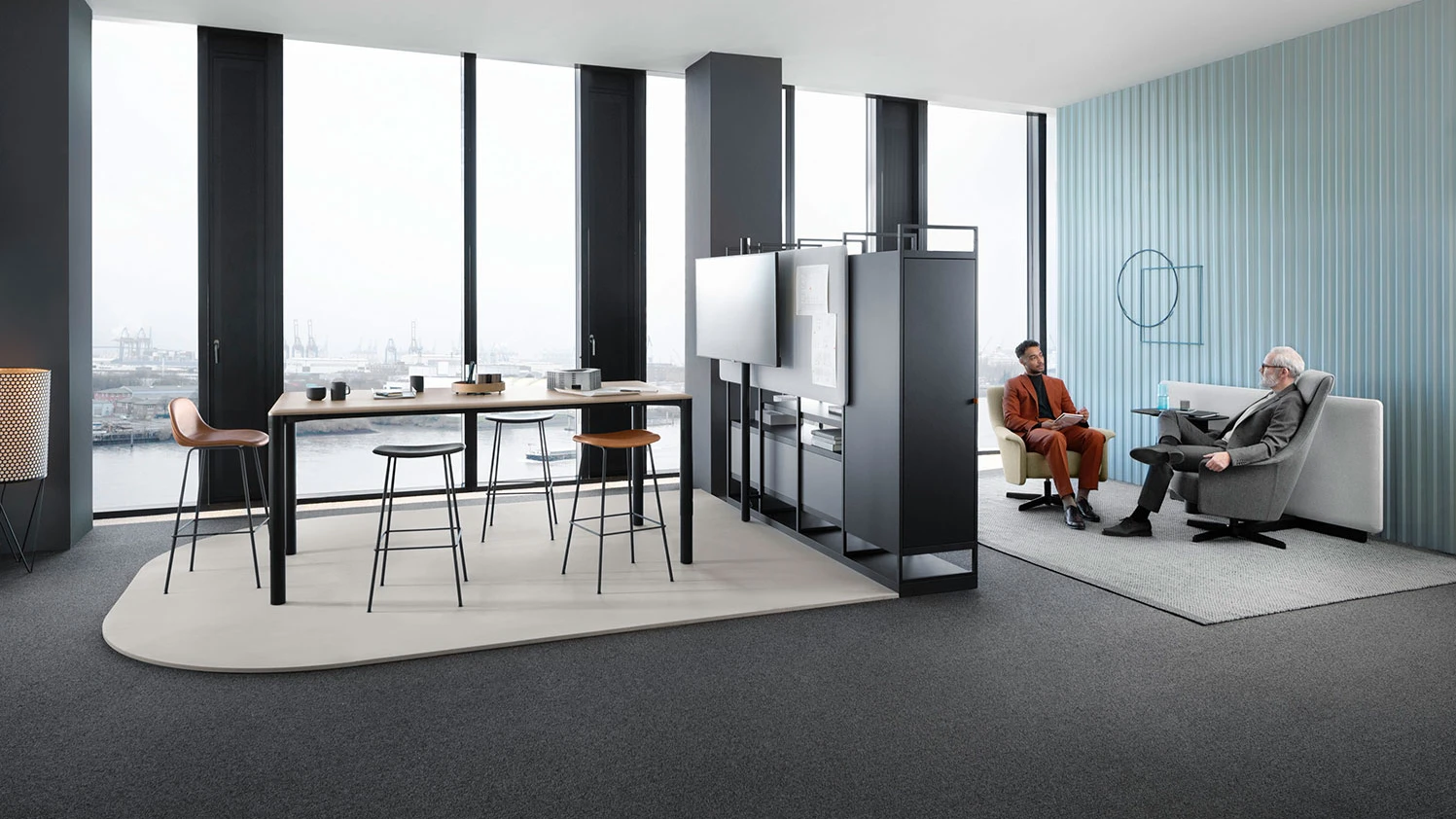
Communication is an important prerequisite for success. It is transported to the public via traditional advertising campaigns, sponsoring, sports and cultural activities and by fostering young talent. Last year, the cityscape was brought into the office in the course of refurbishments carried out at the well-established Credit Swiss headquarters. To this end, Bene developed communication areas and designed new spatial zones. Conversations, meetings and the exchange of information take place against a colourful backdrop, which appears to emerge like a market square with a steeple and a town hall from the well-organised structure of desks. Compact and focussed working areas are complemented by communication stimuli. Visual magnets of the open-plan office are on par with the wide-reaching view of Zurich's cityscape; whilst the brand is ready to embrace the challenges of a global financial market.
Anna Voltren