Bene Office Furniture
Subscribe newsletter
18. Oct. 2007

The world of megabrands: 100 years are not enough!

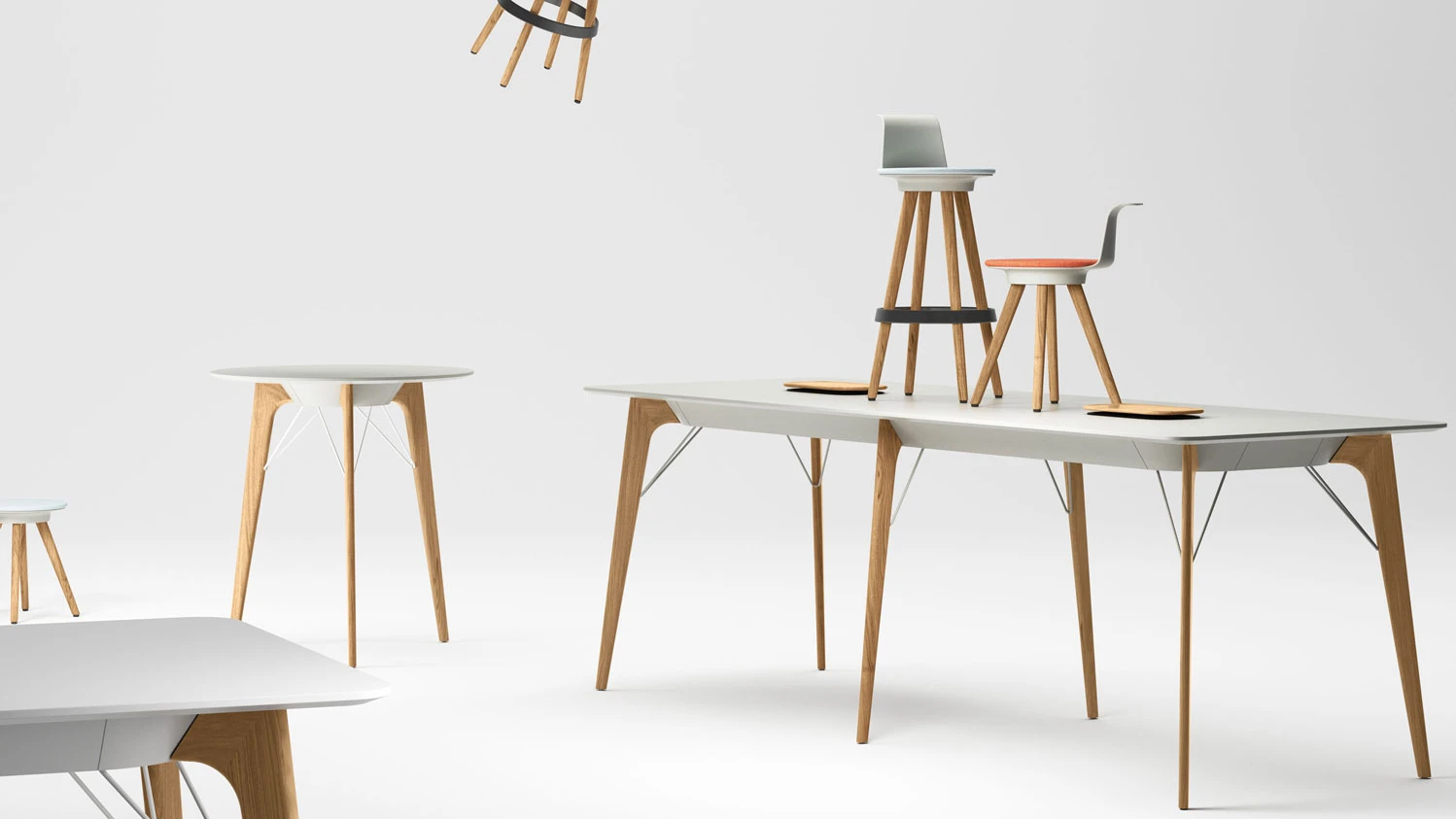
"We are protagonists on the stage of modern office spaces", explains Solis F by Wilkhahn.
"We are protagonists, not just extras", proclaims AL table by Bene.
An imaginary conversation between real objects on the 100-year anniversary of furniture manufacturer Wilkhahn. Bene congratulates.

"What I keep asking myself is – have there indeed been that many changes? Being a chair and a table, we have always formed the basic components of workstations", standing tall, Solis F reviews the past decades in its mind.

"Do you really think so? Just recall the design and our features! What about ergonomics, materials and durability? Things back then and today are worlds apart, you should know that better than anyone else", objects AL assuming a static pose.

"You are right and besides, 50 years ago no one would have placed us where we are today", smirks Solis with an inaudible gesture, remembering the beginnings, when the founding fathers Friedrich Hahne and Christian Wilkening launched their chair factory 100 years ago under the name Wilkhahn. Using the wood of surrounding forests they crafted solid quality products.
"Do you remember the first model, the 351, by Georg Leowald? Who would have thought it to become such a success – it has almost turned into a fashion icon!"


From a crafts enterprise to a trendsetter


"The Bene brand entered the market only in the early 1960s. I know you had already established your line by then. Thanks to contacts with Bauhaus, Werkbund, and the Ulmer Hochschule your zest for experimenting – intentionally or unintentionally – became soon synonymous with the line and propelled you from a crafts enterprise to an international trendsetter. This makes for an early analogy: Bene started out as a local crafts business too…..".

"Yes, it was incredible! I still recall the hype that 224, our stackable chair, created. But the times back then called for new materials and minimalist forms, which were born as a result of the function. Success based on design….incredible….just like the 50s!"

"Talking about minimalist", says AL happily, "Have you heard that Walter Papst’s cantilever plastic chair will be re-launched as a special anniversary edition?"

"Yes, I have – just like the rumour that not only nostalgics are looking forward to that…".

"Since I have already started paying compliments: I was always impressed by how the euphoria of the 50s and 60s has inspired you to produce durable products to increase usability and reduce waste.
In midst of the rapture over global growth this foresight anticipated the ecological wave of the 1980s. Later, Picto’s design and ecological awards reflected perfectly the zeitgeist. But back then, so soon, when everyone else was still celebrating the end of the war and the rebuilding efforts … I am deeply impressed!"


Environmentally-friendly and strong concepts


"Thank you for the compliment", Solis basks happily in the success of its creators and resets its back support. "This has always been part of our philosophy - 'In case of doubt the environmental aspect shall always be prioritised over fast profit' – stated the board of directors in 1989 in its strategy paper… Anyway – exploring our context is one of our strengths. This statement is best embodied by Klaus Franck and Werner Sauer. Their FS line was an innovation in the 80s that has been continued until today! The principle of flexible sitting was skilfully translated into a chair that adapts to the body posture without tedious pre-settings, thus encouraging movement. The line sold more than two million copies and is still part of the product range."

"And this is our most important hallmark! This is how we have joined forces – thinking in terms of concepts, not furniture!", AL becomes emotional. "As embodied by Laurids Ortner’s multiple office in the 70s: We never saw our products only as tables and shelves, but we always looked at the users and their spatial needs, the variety of tasks they need to accomplish and how the office and its furnishing can assist this process. 'First we shape our environment, then the environment shapes us.' This was another innovation that has been continued until today."

"Then we both went on to introduce further improvements. Wilkhahn has expanded more and more, while Bene has expanded too. Both labels were able to make a name for themselves internationally in the 1980s, while they still raise more than half of their revenue in their home countries", Solis is obviously proud of that.


Embracing innovation


"This is how a special German – Austrian partnership began, namely ours!", adds AL. "A partnership whose business activities are guided by lasting common ideals, including a focus on design and functionality, spatial solutions instead of furnishing solutions – and a high level of innovation in all matters of tomorrow’s office world. Our CompactOffice concept, which was developed in the late 90s, and our ideas for ComOffice at the start of the new millennium anticipated the trends of tomorrow."

"Don’t forget about the goal to develop a comprehensive corporate culture, as well as building rapport with staff based on mutual respect and fairness. And of course assuming a leading position in the industry. I believe our labels have always distinguished themselves by these corporate concepts."

"Sounds good and it promises more successful years to come. Our relationship seems to stand firm…!"

"Which is why we should remain true to our former ideals", adds Solis rather enthusiastically than melancholically. "Remain up-to-date and curious, establish connections, design spaces and environments for people with exclusive needs. Pair aesthetics with functionality and maintain a solid partnership. This is how we can help to induce change, in combining work and creativity, responsibility and performance. I can’t think of a better concept."

"We have accomplished many things", comments AL by Bene.

"We have a vision for the future", explains Solis F by Wilkhahn.


Brigitte Schedl-Richter